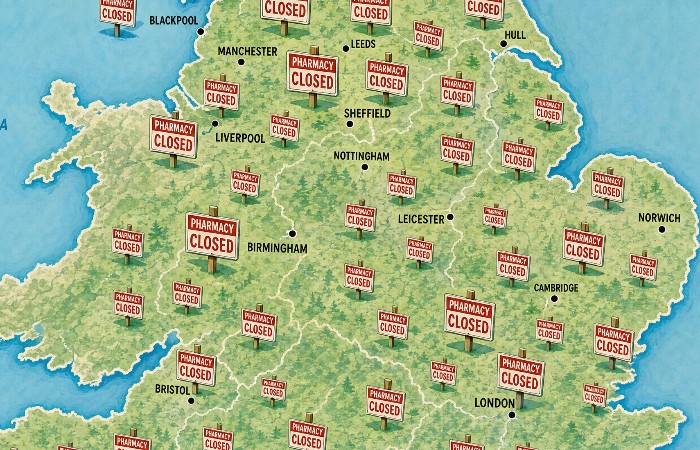
Over 280,000 people in England saw their pharmacy close in first eight months of 2026
Neil Trainis,
28 Sep 2026 2 Min
2 Min

Neil Trainis,
28 Sep 20262 Min
Neil Trainis,
28 Sep 20262 Min


More than 280,000 people in England saw a community pharmacy in their local area close in the first eight months of this year, according to research by the National Pharmacy Association (NPA).
The NPA said its analysis of monthly NHS figures revealed 51 pharmacies shut their doors permanently between January and August because of “chronic underfunding” at a rate of two pharmacies every fortnight.
The NPA also said 31 pharmacies closed despite being on the pharmacy access scheme, which draws £20 million in funding from the community pharmacy contractual framework.
The closure of a former Lloyds Pharmacy in Long Rock, Penzance, left patients with a 17-mile round trip and a one hour, 20-minute journey by public transport to access pharmaceutical care on Sundays, while the closure of a pharmacy in Bishops Lydeard, Somerset, meant patients face a 10-mile round trip to their nearest pharmacy.
“On the weekend, this is a one hour, six-minute journey on public transport,” the NPA said.
The closure of a Lloyds Pharmacy in Barnwood, Gloucester, left patients with a 50-minute walk to their nearest pharmacy at the weekend, or a one hour, 10-minute round trip by public transport, while an Asda pharmacy’s closure in Bodmin, Cornwall, left patients with a 16-mile round trip to their nearest pharmacy on weekends, or a one hour, 10-minute journey on public transport.
“Closures have forced patients to travel significant lengths to access emergency prescriptions as well as contraception and clinical advice, particularly on a weekend,” the NPA warned.
It said 1,500 pharmacies have closed since 2017, affecting 9.9 million people or about a fifth of adults in England. The NPA insisted “relentless” closures have reduced the community pharmacy network to its smallest level for 20 years.
It said its population estimates are based on the latest Office for National Statistics figures “which suggest a high street pharmacy serves an average of 5,930 patients”.
NPA chair Olivier Picard described the figures as “depressing” and warned they highlight that “work to stabilise the pharmacy network that millions of patients depend on is not done yet”.
“We need to act to prevent the permanent closure of pharmacies becoming the new normal at a time when Government and the public wants more care closer to people’s homes,” he said.
“Patients are being forced to travel long distances to access the medicines and support they need, particularly on weekends.
“It is particularly concerning to see closures of pharmacies that have been singled out for additional support due to their importance to the patients that use them and the lack of available alternatives in those areas.”
Insisting the NPA wants to work with Labour “to fundamentally reform the pharmacy contract”, Picard added: “We recognise this Government has provided pharmacies with desperately needed funding uplifts.
“But much of this had to go out the door to meet soaring costs, including business rates and national living wage, leaving pharmacies facing a yawning gap between their costs and the funding they receive from the NHS.”