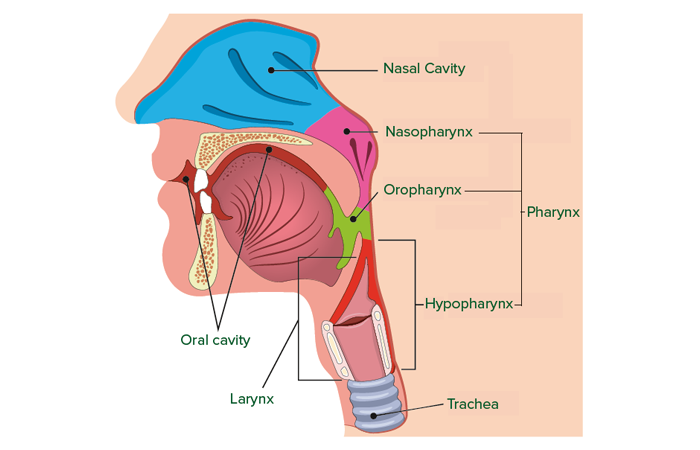
The sinuses are air-filled cavities found in the bones of the face, around the nose and eyes. Like the nasal passages, the sinuses are lined with mucosa which moistens the air that is breathed in, and fine hairs (cilia) that help to remove potentially harmful substances. There are four sets of sinuses, named for the bones of the skulls in which they sit: frontal (just above each eye), maxillary (behind the cheekbones near the jaw), sphenoid (each side of the forehead at the temples) and the ethmoid (around the nasal cavity).
The nose is probably most strongly associated with the sense of smell but it is also hugely important for breathing. Hairs on the inside of the nasal passages filter out particles, and air becomes moist and warm as it travels further into the respiratory tract. Irritation of the nasal mucosa is the main reason why sneezing and a runny nose occurs – they are the body’s way of removing irritants and managing infections.
The throat is the passage from the mouth to the pharynx.
The pharynx has three sections:
The pharynx also contains the tonsils, which are basically lymph glands that help to fight infection.
The larynx marks the division between the upper and lower respiratory tracts. The larynx contains the vocal cords, which produce sounds, and is another safety check for the body in terms of making sure food and air are sent in the correct direction.