

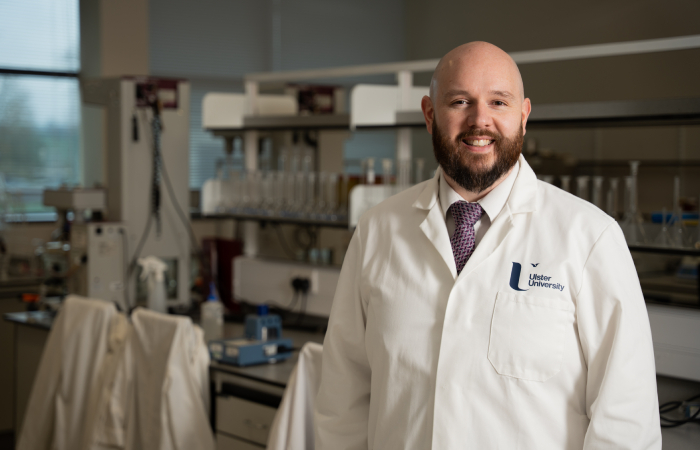
There is an appetite among community pharmacies to support academic health research, but funding is a barrier, a university lecturer has told P3pharmacy.
Dr Aaron Courtenay, senior lecturer in clinical pharmacy at Ulster University, said: “There is a willingness and an appetite from the community pharmacy teams that we work with here in the School of Pharmacy.”
He said the department’s advisory board meetings regularly feature input from community pharmacists and contractors, adding: “We hear loud and clear from some of our partners that they are more than willing to step up and be involved in research activities.”
Dr Courtenay and clinical pharmacy lecturer Kingston Rajiah spoke to P3pharmacy following the university’s announcement of a three-year research project exploring ways in which community pharmacies might be better supported to tackle dependency on OTC codeine products.
Dr Courtenay said: “We have seen over this last number of years a real uptake in some of the interventional type studies.
“So there is certainly a willingness. I can't speak on behalf of my community pharmacy colleagues, but I'm quite sure that that funding is one of the key barriers, and that’s a difficult position that I think many, sectors face across the UK.
“The university context provides a sort of neutral ground to allow some of these, these collaborative ideas to form.
“It allows for the stakeholders, those who would be making policy decisions... to work with community practitioners, pharmacists, healthcare providers to be able to come together and work out what strategies might be suitable, what might work.
He added: “It's about developing the evidence base to support the stakeholders to then make the appropriate decisions thereafter.
“In terms of outcome, I think we have to be led by what the evidence says.
“Once that evidence is generated, that gives those in policy decision-making seats the opportunity to review the evidence and come to a balanced outcome that's acceptable to the people of Northern Ireland or across the UK.”

Commenting on the OTC codeine research, Dr Rajiah said: “We want to understand whether community pharmacy can provide an earlier route or easier route or support to the people who are suffering in, in kind of, in, in these kind of dependency.
“We are looking at how community pharmacists can help someone who may be becoming dependent on the OTC medication specifically.”
Asked what barriers to supporting patients the research might explore, he replied: “It could be regulatory issues. It could be ‘pharmacy hopping’ which is when a person shops around different pharmacies for codeine.
“We are trying to find out how best possible solution we can bring. We'll be liaising with the pharmacists. members of the public and other stakeholders.
“We are trying to bring everyone in and trying to find a very clear, structured referral pathway.”
Dr Courtenay added: “In Northern Ireland, our pharmacists are very well trained and they do support patients very well. One of the issues that they currently face is actually, when our pharmacists do identify these people who need support, what referral pathways are there available?
“How do we route those patients to get the support that they require? Whether that is addiction services support, whether that is potentially actually coming off the pain relieving medicines itself and dealing with the underlying issue, which often requires physiotherapy instead of therapeutics.
“There's a whole host of things that need to be considered in how you manage those patients, and pharmacists have been shown to be good at identifying and supporting them.
“One of the challenges we have is making sure that the system is agile enough to allow those pharmacists to make suitable recommendations and referrals into the various services that those patients might therefore need.
“Early on in this process, one of the very early conversations that we had was with Lisa Byers, the controlled drugs accountable officer in the Department of Health.
“This was very much on their radar as a potential concern – that patients are potentially not being supported as best as they possibly could – and largely because of a system structure. rather than any individual failing of any individual health provider,
“The Department of Health has been running a pilot scheme in East Antrim, and our intention is to hopefully work with those teams and, and learn from what they have gathered and what they've identified and be able to take that forward as part of this research and develop some of those more systems-focused changes that could actually result in either new referral pathways or new mechanisms to help support these patients.
“But that's far down the line. What we need to do is to make sure that we have an evidence base that one, accurately describes the challenges, and then two, through brief interventions and other mechanisms, design appropriate ways that we can help support clinicians.”
He added: “We're very thankful that Northern Pharmacies Limited Trust Fund, which is the charitable arm of a local community pharmacy group here in Northern Ireland, has stepped forward and provided significant funding to support this particular project.
“This is a live issue and something that pharmacists across Northern Ireland and indeed I think the UK and Ireland, albeit in different contexts, are dealing with daily, and they want to make sure that that community pharmacy is there front and centre in the solutions to this.”


