Freeport CEO: Why we partnered with pharmacists for heart check ‘health bus’ scheme
Arthur Walsh,
18 Sep 2026 4 Min
4 Min

Arthur Walsh,
18 Sep 20264 Min
Arthur Walsh,
18 Sep 20264 Min


Thames Freeport interim CEO Stuart Rimmer tells P3pharmacy why community pharmacists were the right partners for a recent health bus scheme
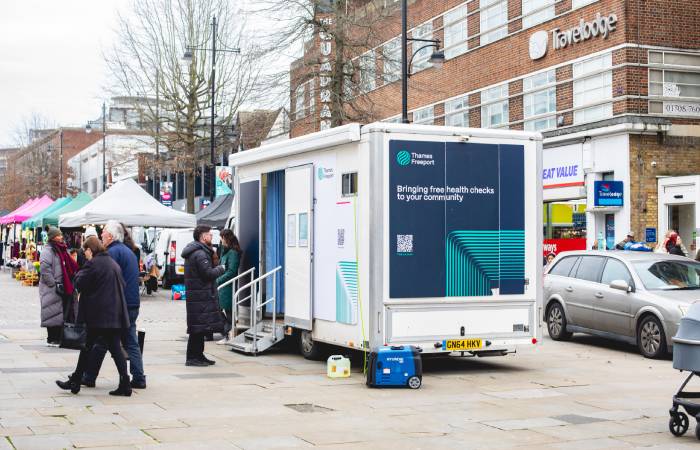
A recent health bus initiative in east London saw Thames Freeport reach out to Local Pharmaceutical Committees to offer pharmacist-led heart health checks, achieving some impressive results. A total of 687 people received point-of-care cholesterol testing and cardiovascular risk assessments, with 211 turned away because the bus was full.
Over half of those visiting the bus were from ethnic groups that have a higher risk of diabetes and heart disease. Thames Freeport says 60 per cent of service users were men – “well above typical NHS Health Check uptake” – and that 78 per cent had not had a health check in the last five years.
Eighty-six per cent gave consent to have their results shared with their GP, with one in five found to be at elevated risk of heart disease and 25 cases flagged for urgent follow up by doctors.
Thames Freeport estimates the scheme saved the NHS £192,928, 1.83 times the amount that was invested in the pilot with the cost per patient falling from £119 in week one to £41 in the final two operating days as utilisation increased.
Community Pharmacy North East London CEO Shilpa Shah tells us:“For the pharmacists and the staff delivering the service it was great to get out into the community and be able to share all the things that community pharmacy can offer without the pressures of other services and dispensing etc in the background. Health checks are something that community pharmacy are very used to so there was no additional training other than training on how to use PocDoc tests. There were no challenges faced by staff. The service demonstrated that there is still work to do on educating the public on the various services that community pharmacy can offer.”
We caught up with Stuart Rimmer, interim CEO at Thames Freeport, to learn more about the initiative.
Thames Freeport exists to bring £4.5bn of private investment and 21,000 jobs to Barking and Dagenham, Havering and Thurrock. But to realise those benefits, we must raise productivity, widen access to employment and build a broader skills base. None of that is possible without improving the health of our residents.
Our three areas experience some of the worst preventable ill health in England. Barking and Dagenham has the seventh highest diabetes prevalence in the country and the second highest rate of long-term conditions among 20- to 64-year-olds. Havering's hypertension-related death rate is around 197 per 100,000, well above the national average.
Working with regional and international partners, we explored how to deliver accessible, effective preventative healthcare in the community.
Thames Freeport funded the pilot, which came from business rates retained in the Freeport tax sites that we spend it on programmes approved by our public-private partnership and our board. This was a decision of the partnership, taken with the three local authorities and our private sector partners in the room.
Engagement with Community Pharmacy North East London or Community Pharmacy Essex started from scratch. Thames Freeport commissioned a consortium led by Avencera, supported by PUBLIC and L Marks, to design and run the pilot.
They assessed options for delivering community screening at scale and at a cost that could ultimately be commissioned by the public sector. Community pharmacy emerged as the strongest route. Pharmacies already hold permissions for blood pressure and diabetes testing, but that capacity is often underused.
The consortium worked with Community Pharmacy North East London, representing more than 350 pharmacies, and Community Pharmacy Essex to co-design the service rather than simply staff it. Pharmacists and pharmacy technicians subsequently delivered every screening on board.
Esri UK provided the population health layer: deprivation, prevalence of diabetes and hypertension, and the places where primary care has not kept pace with new housing.
FourthSpace used IoT sensing and geospatial analytics to predict foot traffic at particular sites at particular hours, so the delivery team could place and time each deployment for reach.
Ninety-six per cent of deployment days were rated good or very good for footfall. Around 164 people passed the bus daily. It was at or near capacity on more than 60 per cent of days. The unit economics followed, and on daily operating costs cost per patient fell from £119 in the first week to £41 across the final two operating days, because the fixed cost of a day spreads across a fuller queue.
The £192,928 is an estimate of NHS cost avoided, produced by the independent evaluation of the pilot.
It sits within the evaluation's value for money assessment and is attributed to downstream avoidance: cost the health system is likely not to incur because cardiovascular and metabolic risk was identified earlier than it otherwise would have been. Set against a pilot investment of £105,400, the evaluation puts the return at 1.83 times.
This is a modelled estimate rather than a saving that has been banked. Longer-term impacts require further validation, and an eight-week pilot cannot show what then happened to patients over the years that follow, and we do not claim that it does.
Yes, on three fronts.
The evaluation shows it works, and demand exceeded the capacity of a single vehicle. Sustainability options are being explored through pharmacy, occupational health, public sector commissioning and technology partnerships.
Multi-year funding has been secured to expand screening, strengthen targeting and extend delivery beyond the Freeport boundary.
Together with our Health AI and CarePort programmes, the bus forms part of a single pathway spanning prevention, primary care and complex care.