1 Min
1 Min

In CPD

Bookmark

It goes without saying that the skills your team have are important in delivering a good service. But when we look at the skills we have in the pharmacy team, we need to make sure they are being used effectively.
The traditional managerial approach – looking at how the team perform and then working with individuals to improve their skills to make the best of the situation – will deliver incremental changes.
But if you are hoping for meaningful, system-wide change, a leadership approach using triple-loop learning may prove to be more effective.
An organisational design approach involves taking a step back from the people and looking at what the organisation wants to achieve and using that as the basis for a capability and people plan. Such an approach obviously requires a business plan but, done properly, it also questions the status quo to create the structure and processes your business needs to meet its goals.
Single-loop learning looks at what we do and asks us to think about whether we are doing it correctly. Can we make adjustments to do things better? Learning happens through practice and experience, training and coaching. It provides incremental changes.
Double-loop learning takes a step up. It asks us to examine whether this is the right process. Can we do it more effectively? This type of learning gives us bigger gains when we apply it because it requires an understanding of causality. It is about doing the right things. At this level in a team, we might ask whether we have the right people in the right roles.
Triple-loop learning goes deeper to explore why we even have the systems and processes we have in the first place. It is the type of learning most associated with wanting to lead. It is the most difficult, but it produces the best results.
Triple-loop learning asks us to re-evaluate what we are trying to achieve. We might be using the right process and doing it well, but is it delivering the outcomes we want? It requires us to think about our purpose and assess whether we have the right roles to deliver the business’s potential.
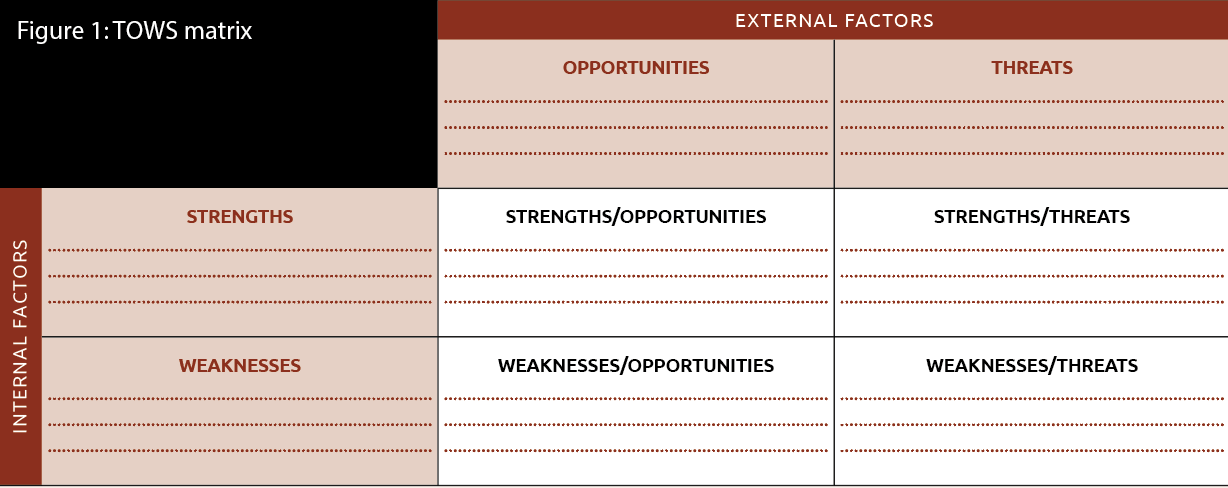
This can be supported using another business planning tool. You are probably familiar with a SWOT analysis, through which you look at the strengths, weaknesses, opportunities and threats that affect your business. Strengths and weaknesses are internal functions of your current business. Opportunities and threats are external context. Analysing all four provides a snapshot of the current situation.
However, when thinking about skills across your team, a SO WhaT analysis (also known as a TOWS analysis) is more useful as it goes further to match up those strengths with the opportunities, and the threats with the weaknesses, to create actions for you to take from your initial analysis.
For example, you might identify the annual NHS flu vaccination service as an opportunity you are not making the most of. The weakness is that the pharmacist does not have time to do the vaccinations. One strategy to overcome this might be for them to delegate responsibility for managing all the processes in the dispensary to a technician.
Alternatively, you might see the administration required to deliver the services you provide as a threat that could lead to inefficiencies and losses. The weakness might be that there is no single individual focused on completing the paperwork. An action to overcome this might be to make all admin tasks, that do not need to be undertaken by the pharmacist, a main responsibility within one role.
In a formal work and skills planning process, after identifying actions to be taken across the business, the next step would be to bring together meaningful groups of tasks to create roles that meet the needs of the future business which maximise the opportunities and mitigate the threats.
You might decide, after examining all of your workload data, that repeat prescriptions might be dispensed more efficiently when the pharmacy is closed, under the supervision of a technician, allowing walk in customers to be prioritised during opening hours.